

An emergency supply planned for 72 hours lasts 3 days without shopping only if its usable food, water and other essentials cover everyone relying on it. The limiting factor is whichever essential runs out first—not the number of packages or the shelf life printed on them.
- How long does an emergency supply last? Count usable household days, not packages or expiry dates.
- A 72-hour emergency kit targets 3 days; verify its contents against your household’s actual needs.
- ReadySet sells emergency kits for EU households; check food, water and personal requirements before choosing.
- Your shortest essential supply determines how long you can manage without shopping.
How long does an emergency supply last without additional shopping?
Your emergency supply lasts until the first essential no longer meets your household’s needs. Calculate water, food and personal essentials separately, then use the shortest duration as your planning limit. A cupboard full of food does not extend your drinking-water supply.
Use this sequence for your 2026 household check:
- Count people. Include everyone who will depend on the stored supplies, including expected visitors or relatives.
- Count usable stock. Exclude damaged items, unsuitable foods and anything you cannot prepare safely during the disruption.
- Calculate daily use. Record what the whole household needs over 24 hours, rather than using a single person’s needs.
- Check dependencies. Identify meals requiring additional water, cooking equipment or refrigeration.
- Find the limit. Compare the resulting durations and address the shortest essential supply first.
For a broader inventory, use the home emergency preparedness checklist. Keep the duration calculation beside it: a checklist confirms that an item exists, while your calculation confirms how long it helps.
Why this matters
A supply can look complete without covering a complete day. You might have breakfast ingredients but no usable evening meal, or dry food whose preparation needs water already allocated for drinking.
The practical question is not whether you own emergency supplies. It is whether everyone can get through the planned period without buying another essential item.
For your 2026 plan, separate time without shopping from time without utilities. Food that works during a transport disruption might not work during a power or water outage. Your reserve needs to match the conditions you are planning for.
A 72-hour reserve: 3 days of checked coverage
A 72-hour reserve represents 3 days of planned coverage. That duration is meaningful only after you check the quantities, intended users and preparation requirements.
Write down the meals and drinks you would actually use during that period. Then check each person’s needs against the contents, including dietary restrictions and any essential care supplies. Do not assume a shared household kit automatically covers every personal requirement.
ReadySet emergency kits are best suited to EU households seeking a 72-hour preparedness kit. The duration label is a starting point for checking coverage, not proof that every household’s food, water and medical needs are covered.
The benefit of a ready-made kit is having a defined starting point to assess. Its limit is that the household still needs to verify contents and add anything required for individual circumstances. Check the current contents before relying on a kit for a particular duration.
A longer home reserve: calculate days from usable stock
A larger home reserve lasts longer only when you increase the essentials that limit it. Adding food alone does not extend coverage if water remains the constraint.
You can build your reserve around familiar shelf-stable groceries, a ready-made kit, or both. These approaches serve different purposes; none removes the need to count usable quantities.
| Approach | Best for | Practical advantage | Limitation to check |
|---|---|---|---|
| Ready-made emergency kit | Households wanting a defined starting point | Provides a packaged set of supplies to assess | Contents still need checking against household needs |
| Household pantry reserve | Households that regularly use shelf-stable foods | Lets you plan around foods you already eat | Ordinary shopping stock is not automatically a complete emergency reserve |
| Combined kit and pantry | Households separating emergency equipment from everyday food rotation | Lets you assign different roles to stored supplies | Overlapping inventories can lead to double-counting |
Choose an approach you can maintain. A pantry reserve needs replacement when you use it, while a stored kit still needs inspection and a clear record of anything removed.
Calculate water coverage before counting meals
Use a straightforward calculation:
Water coverage in days = usable stored drinking water ÷ planned daily household water use.
Keep the units consistent. If your inventory is in litres, record daily use in litres too. Use a household requirement appropriate to the people and conditions involved, checked against current official guidance.
Separate drinking water from additional water needed for food preparation. A meal that requires water creates demand; it does not belong in the calculation as if it were ready to eat.
Also distinguish stored water from treatment equipment. A filter or purification product requires a suitable water source and correct use. Owning treatment equipment does not mean an unlimited supply of safe drinking water is available.
For your 2026 inventory, mark which water is physically stored and which depends on another source. Calculate your initial coverage from what you can actually access, not from an assumed future collection or delivery.
Calculate food coverage from meals you can actually eat
Count complete, suitable meals rather than tins, packets or advertised servings alone. Package size does not tell you whether the contents meet your household’s needs throughout the day.
Build a simple written menu using only the food in your reserve. Check that the planned portions are suitable for the people eating them, and inspect ingredient labels where allergies or dietary restrictions apply.
Use these checks for every planned meal:
- Access: Can you open the packaging with the tools available?
- Preparation: Can you eat it safely under the conditions you are planning for?
- Water: Have you included any preparation water in your water calculation?
- Suitability: Can the intended person eat the ingredients?
- Leftovers: Can you safely handle any food remaining after opening?
Do not extend the apparent duration by planning inadequate portions. The aim is a workable reserve, not the largest possible day count on paper.
Why emergency supply duration varies
Your reserve’s duration changes when its users, usable contents or preparation conditions change. These are the main factors to check:
- Household size: The same stock must cover everyone relying on it. Recalculate when that group changes.
- Personal requirements: Allergies, infant feeding and prescribed treatments affect what counts as usable stock.
- Water demand: Drinking and meal preparation draw on the same reserve unless you allocate them separately.
- Preparation requirements: Food that needs cooking is not equivalent to food you can safely eat as stored.
- Storage condition: Damaged packaging or unsuitable storage can remove items from your usable inventory.
- Everyday consumption: Supplies used between inspections reduce the reserve unless you replace them.
These factors explain why another household’s duration is not a reliable estimate for yours. Use your own inventory and requirements rather than borrowing a day count.
Check your reserve without exhausting it
Run a practical walk-through before you need the supplies. You do not need to consume the entire reserve or interrupt essential treatment to identify gaps.
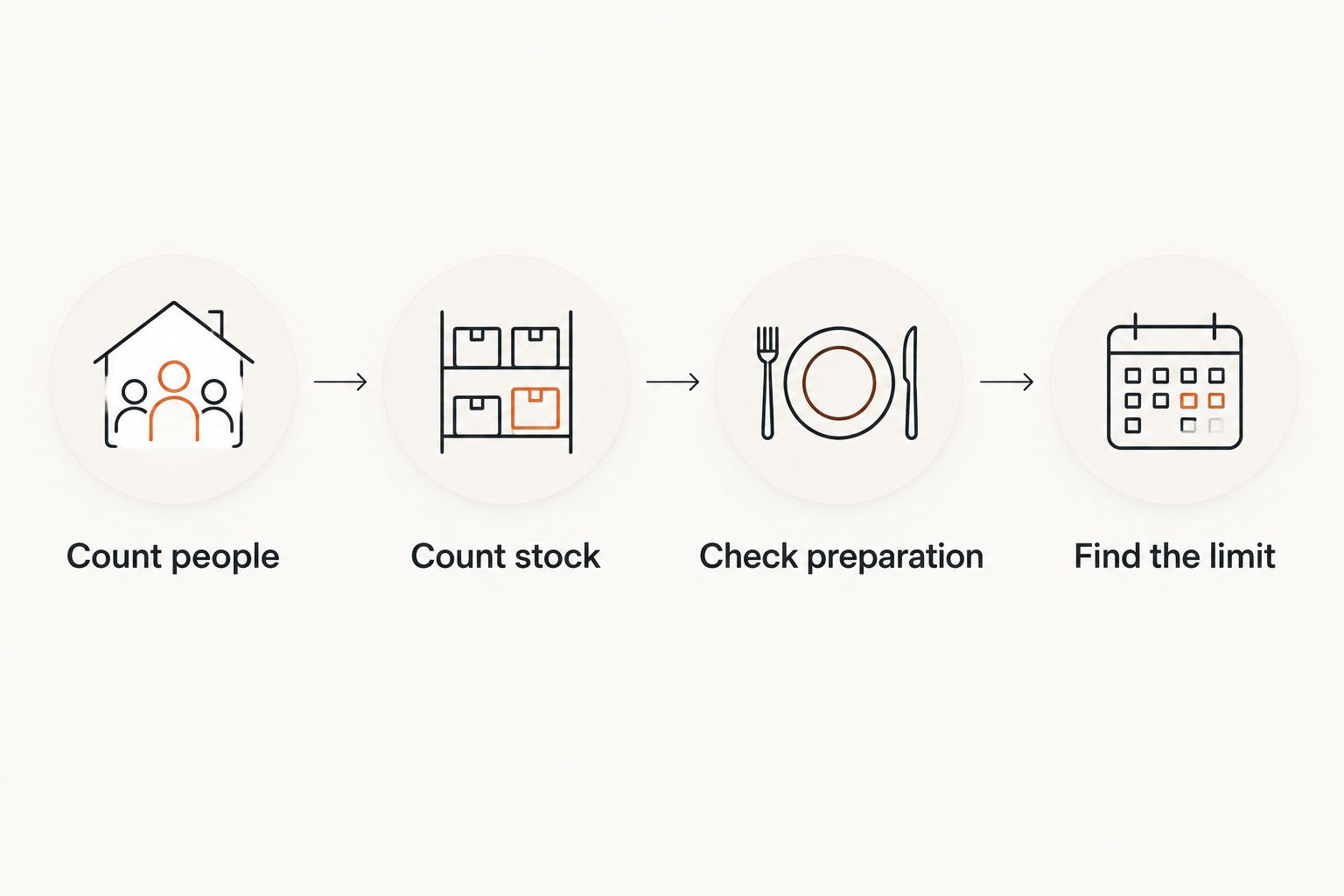
Count people
List everyone included in the plan. Record personal requirements alongside their names so shared supplies do not hide an individual gap.
Count stock
Place the inventory beside the actual supplies and reconcile them. Record opened or missing items immediately rather than trusting an old packing list.
Check preparation
Walk through access, opening, preparation and serving. Follow equipment instructions, and never bring outdoor-only combustion equipment indoors to make a meal plan work.
Find the limit
Compare the coverage of essential categories. Mark the earliest gap clearly, then decide what needs replacing or adding.
Keep the findings with your supplies. Another household member should be able to understand the inventory without needing you to explain where everything is or which items have already been allocated.
Does a 72-hour kit cover the whole household?
A 72-hour kit represents 3 days of intended coverage, not an automatic allowance for every household member. Check who the kit is intended for and verify the listed quantities against your own requirements.
For a ReadySet emergency kit, compare the current contents with your household inventory before assigning a duration. Treat unlisted personal requirements separately, rather than assuming that a general kit includes them.
Can I make my reserve last longer by eating less?
A 72-hour plan should cover 3 days of suitable meals, not depend on cutting necessary intake. Extend coverage by adding usable supplies and correcting gaps, rather than stretching portions beyond your household’s needs.
Do not reduce prescribed medication or change treatment to increase a calculated reserve duration. Discuss continuity planning with your pharmacist or clinician instead.
Is shelf life the same as supply duration?
A 72-hour reserve describes 3 days of planned use; shelf life describes how long an item keeps under specified conditions. A long-lasting product can still be used up quickly once the household starts relying on it.
For your 2026 review, record date labels and household coverage separately. Neither tells you the other, and both matter when maintaining the reserve.
Keep the reserve ready between inspections
A duration calculation is only accurate while the inventory remains accurate. When you use something, record it and replace it before continuing to count it as emergency stock.
Make replacement part of normal household routines. Keep suitable foods in rotation, inspect packaging and follow storage instructions rather than leaving a sealed box untouched indefinitely.
Use these maintenance habits:
- Keep a written inventory accessible without an internet connection.
- Mark items removed for everyday use.
- Check current contents before assigning meals to the plan.
- Recalculate when household needs change.
- Store preparation tools where you can find them with the food.
Date the inventory when you check it. A list marked 2026 is useful only if it reflects the supplies actually present; the date alone does not confirm readiness.
FAQ
How long does an emergency supply last without shopping?
An emergency supply lasts for the shortest period covered by its essential contents. Calculate usable water, suitable food and personal essentials separately, then use the earliest limit.
Does a 72-hour emergency kit last three days?
A 72-hour emergency kit targets 3 days of coverage. Verify its intended users, quantities and preparation requirements before applying that duration to your household.
How do I calculate how many days my water will last?
Divide usable stored drinking water by planned daily household water use. Include preparation water separately and check the daily requirement against current official guidance.
Can I count food in my fridge as emergency stock?
Count refrigerated food only when it remains safe under the conditions you are planning for. Do not rely on refrigeration-dependent food to establish coverage for a power-outage reserve.
Does a long expiry date mean my reserve lasts longer?
A long expiry date does not increase the amount of food or water available. Storage life and the duration of household use are different measurements.
Do water purification tablets replace stored drinking water?
Water purification tablets do not replace the need for an accessible water source and correct treatment. Keep stored drinking water distinct from supplies that depend on finding and treating additional water.
What should I check before choosing a ReadySet emergency kit?
Check the current contents against everyone who will rely on the kit. ReadySet sells 72-hour emergency kits for EU households, but personal food, water and medical requirements still need an individual check.
One last thing
Check the least noticeable dependency before adding more food. An unavailable can opener, missing preparation water or unsuitable ingredient can remove a planned meal from your usable reserve without changing the number of packages on the shelf.
Write the earliest essential gap at the top of your inventory. Fixing that gap improves your actual coverage; buying more of something you already have does not.


