

You can tell whether emergency food needs replacing by checking the date wording, packaging, storage history and signs of spoilage—not the date alone. A passed best-before date does not automatically make food unsafe, but food past its use-by date, leaking containers and swollen cans should not stay in your emergency supply.
- A best-before date concerns quality; a use-by date concerns safety. Treat them differently when checking emergency food.
- Discard swollen, leaking or badly damaged food containers without tasting their contents.
- Normal appearance and smell cannot prove that emergency food is safe.
- ReadySet supplies 72-hour emergency kits for EU households; individual food labels still govern storage and replacement.
How can you tell if emergency food has expired?
Read the label first, then check whether the packaging and storage conditions still support it. For a 2026 cupboard check, assess each food item separately rather than treating the whole kit as having one expiry date.
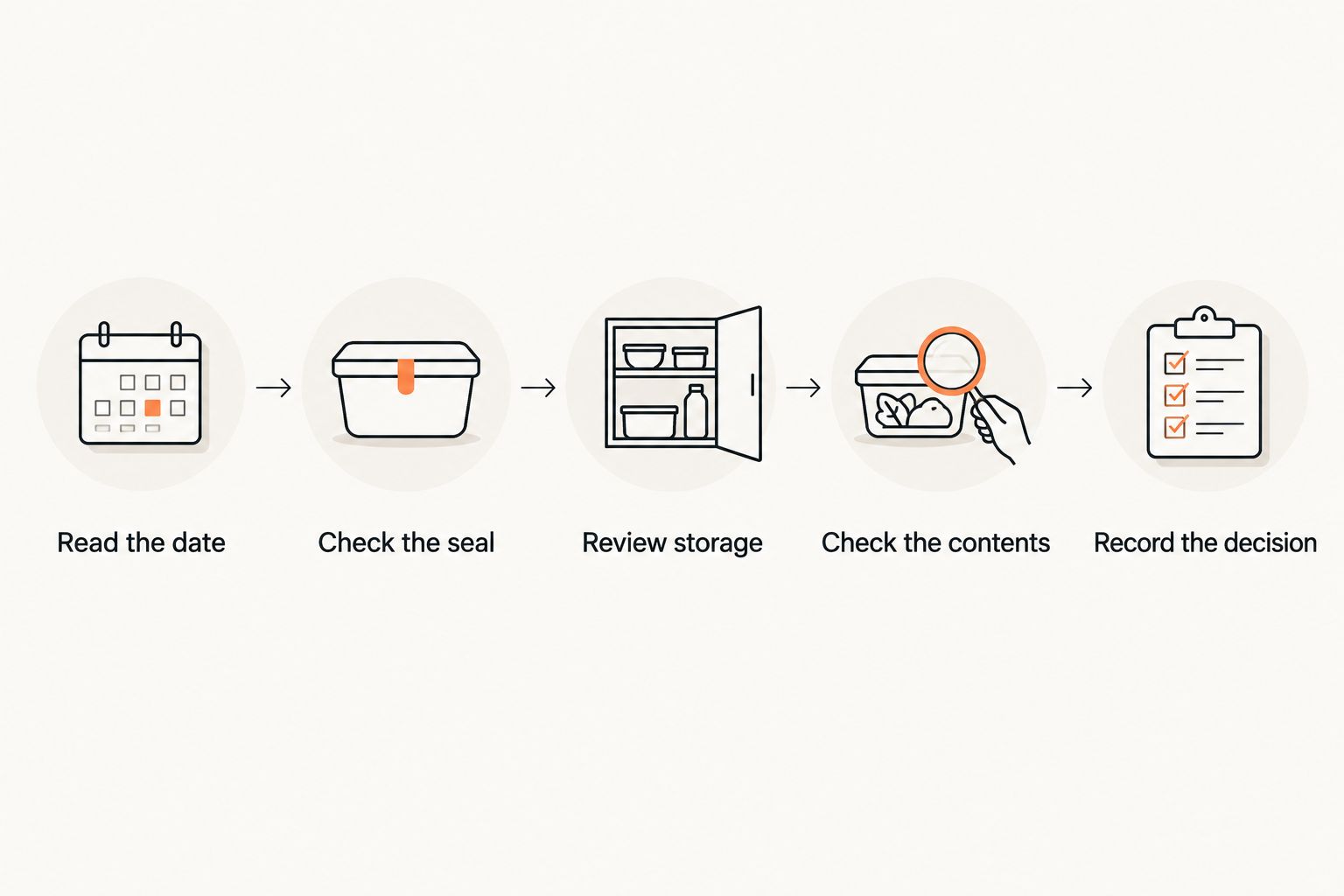
Use this sequence:
- Read the date. Identify whether the label says best before or use by. On German packaging, look for mindestens haltbar bis or zu verbrauchen bis.
- Check the seal. Look for leaks, swelling, punctures, broken seals, serious rust or deep dents affecting a can’s seams.
- Review storage. Confirm that the food stayed within its labelled storage conditions and was not exposed to flooding, excessive heat or moisture.
- Check the contents. Only open packaging that has passed the earlier checks. Unexpected mould, insects, moisture or an abnormal smell means the food needs discarding.
- Record the decision. Keep suitable items, move appropriate best-before foods into normal household use, and replace anything unsafe or uncertain.
No inspection makes damaged food safe. If a package fails a safety check, stop there rather than opening it for reassurance.
For the wider household supply, ReadySet offers emergency kits intended for 72-hour preparedness. Checking individual food items remains part of maintaining any kit.
Why this matters
Emergency food needs to be dependable when shopping, cooking or refrigeration is disrupted. A cupboard full of questionable packets creates another decision when you already have enough to manage.
The opposite mistake is throwing away every item as soon as its best-before date passes. That date describes expected quality under the stated storage conditions; it is not the same as a safety deadline.
For your 2026 review, separate those decisions: Is this food safe to consider using, and is it dependable enough to remain in the emergency reserve? An item can be suitable for ordinary household use without being the right choice for continued emergency storage.
Best before: a quality date, not automatic spoilage
A best-before date tells you how long the manufacturer expects the unopened food to retain its specified quality when stored correctly. Passing that date does not automatically mean the food is unsafe.
However, the date is not permission to ignore damage. A leaking can or damp food pouch needs attention even when its best-before date is still ahead.
For an intact item past best before:
- Read any manufacturer guidance about storage and use.
- Confirm that you know how the item was stored.
- Check for packaging damage before opening it.
- Inspect the contents for unexpected changes where appropriate.
- Replace it in the emergency reserve if you cannot confidently assess it.
There is no single extra shelf-life allowance for all emergency foods. The recipe, processing method, packaging and storage conditions differ, so avoid applying a blanket extension to everything in the cupboard.
Use by: a safety deadline
A use-by date applies to food that can become unsafe even without obvious changes in smell or appearance. Do not eat food after its use-by date simply because it looks normal.
Many shelf-stable emergency foods carry best-before dates, but check rather than assume. Refrigerated additions and other foods stored alongside your kit can follow different rules.
The distinction also matters when a power cut affects refrigerated food. A date printed on the pack does not override storage instructions or make food safe after unsuitable temperature exposure.
European Commission and European Food Safety Authority guidance on consumer date marking distinguishes best-before quality dates from use-by safety dates. That distinction applies to everyday groceries as well as food set aside for emergencies.
What should you check on different emergency foods?
Different packages fail in different ways. Use this comparison during your 2026 inventory, and follow the instructions on the actual item whenever they are more specific.
| Food or package | Useful feature | Main limitation | Replacement warning |
|---|---|---|---|
| Metal cans | A rigid container protects the contents while intact | Damage around seams can compromise the seal | Swelling, leakage, deep seam dents or extensive corrosion |
| Shelf-stable meal pouches | Flexible packaging is easy to handle and inspect externally | Small punctures and damaged seals are easy to overlook | Leaks, unexplained swelling, punctures or split seals |
| Dry foods in sealed packets | Dry storage supports keeping quality | Moisture and pests can enter damaged packaging | Dampness, mould, insects or damaged inner packaging |
| Emergency ration bars | Individually sealed portions can remain separate until needed | A sound outer box does not prove each wrapper is intact | Torn wrappers, moisture, mould or an abnormal rancid smell |
| Opened foods | Contents are accessible for ordinary household use | The unopened shelf-life claim no longer describes the item | Failure to meet after-opening storage or use instructions |
An outer carton is not the food’s protective seal. Remove enough outer packaging to inspect the actual cans, wrappers or pouches without opening them unnecessarily.
Cans: inspect the seams, not just the front
Turn each can so you can see its lid, base and seams. A small superficial dent is different from a deep dent that affects a seam, but do not keep a can when you cannot judge whether its seal remains sound.
Never taste food from a swollen or leaking can. Botulism toxin cannot reliably be detected by sight, smell or taste, so an apparently normal smell is not a safety test.
Do not open a bulging container to investigate. Keep it away from children and pets, and follow local food-safety or waste-disposal guidance for suspect canned food.
Pouches: inspect edges and seals
Check the entire pouch, especially corners and sealed edges. Food residue outside the pack, a sticky seam or a puncture calls its integrity into question.
Some products are intentionally packed with gas, so not every pouch containing air is spoiled. Compare its condition with the manufacturer’s packaging description; unexplained swelling or a new change is a reason not to eat it.
Dry foods: look for moisture and pests
Check dry meals, crackers and powders for damaged packaging, insect activity and unexpected dampness. Clumping alone is not a universal spoilage test, but new clumping together with moisture or damaged packaging needs investigation.
For mouldy dry emergency foods, discard the affected food rather than removing the visible patch. Moving compromised contents into a clean container does not reverse contamination.
Why emergency food’s condition varies
The printed date assumes particular conditions. These factors explain why similar-looking items can need different decisions:
- Date type: Best-before and use-by labels answer different questions about quality and safety.
- Packaging integrity: A puncture, failed seal or damaged seam removes protection that the shelf-life claim depends on.
- Temperature exposure: Heat can reduce keeping quality; follow the manufacturer’s storage instructions rather than assuming a garage or car is suitable.
- Moisture exposure: Dampness can damage packaging and encourage mould or pest problems.
- Opening and handling: Opening a package changes its storage requirements and introduces opportunities for contamination.
- Food composition: Fats can become rancid, while different processing and preservation methods produce different storage needs.
Storage history deserves particular attention when you move a kit. A packet transferred from a damp shed to a dry cupboard does not regain the condition it had before that exposure.
Can I eat emergency food after its best-before date?
Food past its best-before date is not automatically unsafe, provided its packaging is intact and it has been stored correctly. Assess the specific item and follow manufacturer guidance; discard it if you find spoilage or cannot establish safe storage.
For emergency planning, move suitable items into normal use before their dates where practical. Replace them in the reserve rather than relying on an assumed extension.
Can I tell whether emergency food is safe by smelling it?
Smell alone cannot establish food safety. An abnormal smell is a reason to reject food, but the absence of one does not clear a damaged package, an expired use-by item or food stored incorrectly.
Do not taste questionable food as a final check. When safety is uncertain, replacement is the appropriate decision.
Does opening a packet change its expiry date?
Opening a packet changes the storage conditions behind its original shelf-life claim. Follow instructions such as refrigerating after opening or consuming within the period stated on the label.
Write the opening date on the container when useful. Do not put a partly used packet back into long-term emergency storage as though it were unopened.
Build a simple replacement routine
Make your 2026 food check a repeatable household task. Keep the record beside the supply or somewhere every adult in the household can find it.
Use these fields for each item:
- Food name and quantity.
- Printed date and whether it is best before or use by.
- Storage and preparation instructions.
- Dietary or allergen considerations.
- Inspection result and replacement action.
As a practical scheduling choice, set a full review every 6 months and a reminder 1 month before an item’s printed date. These are organisational reminders, not food-safety limits; inspect sooner after leaks, pest activity, flooding, unusual heat or a move.
Use the emergency-kit expiry reminder workflow to turn that inventory into calendar tasks. Include the item name in each reminder so the notification tells you what to check.
Put earlier-dated foods where you can reach them first. Replace anything you remove for normal meals immediately, rather than leaving an unnoticed gap in the reserve.
ReadySet is best for EU households looking for 72-hour emergency kits. A prepared kit provides a starting point; it does not replace checking labels, dietary suitability and the condition of individual items.
Review your household emergency setup
Explore ReadySet’s 72-hour emergency kits, then check individual labels against your household’s needs.
FAQ
How do I tell if emergency food has expired?
Check whether the label says best before or use by, then assess packaging integrity and storage history. Discard food past its use-by date and reject swollen, leaking or compromised containers without tasting their contents.
Is emergency food safe after its best-before date?
A passed best-before date does not automatically make emergency food unsafe. Correct storage, intact packaging and the condition of the specific food still matter; there is no universal extension for every product.
Should I open a swollen food can to check it?
No. Do not open or taste food from a swollen can. Keep the container away from children and pets, and follow local guidance for disposing of suspect canned food.
Can emergency food be unsafe before the printed date?
Yes, emergency food can become unsafe before its printed date if its packaging is compromised or storage conditions are unsuitable. The date does not override leaks, contamination or damaged seals.
How often should I check my emergency food supply?
A review every 6 months is a practical household scheduling choice, not a guarantee of safety between checks. Inspect sooner after damage, flooding, pest activity or unsuitable storage, and follow each label’s instructions.
Does a normal smell mean an emergency meal is safe?
No, a normal smell does not prove an emergency meal is safe. Some hazards do not produce a detectable smell, so date type, packaging and storage history remain essential.
Do I need to replace the whole kit when one food item expires?
An expired food item does not establish that every other item in the kit needs replacing. Check each component separately and replace the affected food while maintaining the supplies your household needs.
One last thing
A sealed meal is not a usable meal unless you can prepare it. During your final 2026 check, read whether each item needs drinking water, heating, utensils or a can opener.
Keep those requirements alongside the food inventory. ReadySet emergency kits belong within a household plan that checks not just what is present, but what your family can actually use during a disruption.


